Kisspeptin 10mg
Chemical Specifications
- Form
- Lyophilized Powder
Certificates of Analysis
Product Description
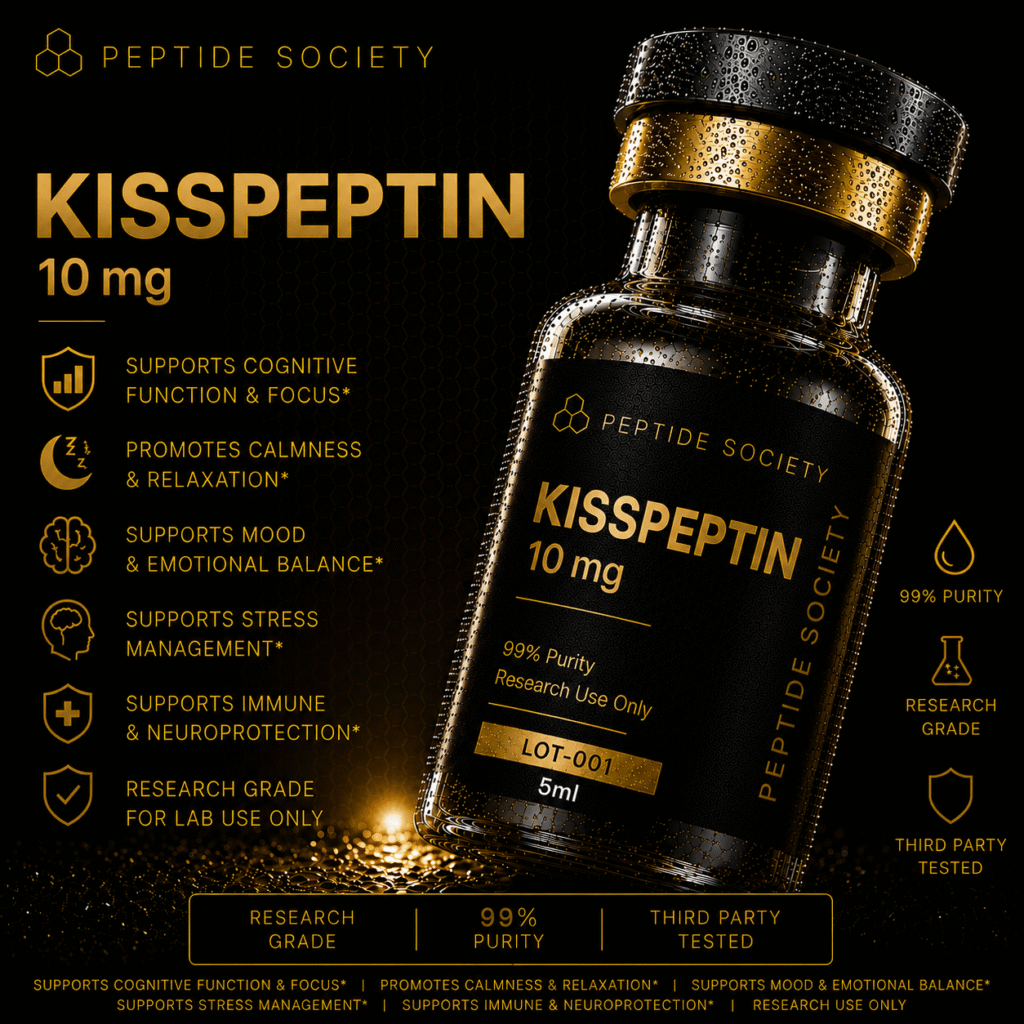
Kisspeptin 10 mg
Research-Grade Kisspeptin 10 mg
Peptide Society’s Kisspeptin 10 mg is a high-purity, lyophilized research peptide intended exclusively for laboratory and scientific research. Manufactured to rigorous quality standards, each vial is tested for identity and purity to provide researchers with a consistent and reliable material for preclinical investigation.
Kisspeptin has become one of the most studied neuroendocrine peptides due to its role in regulating the hypothalamic-pituitary-gonadal (HPG) axis. Researchers continue to investigate its biological activity, receptor signaling, and potential influence on reproductive physiology, endocrine communication, and neurobiology.
Product Specifications
- Product: Kisspeptin
- Strength: 10 mg per vial
- Purity: ≥99%
- Form: Lyophilized Powder
- Storage: Refrigerate before and after reconstitution.
- Research Use Only
Research Overview
Kisspeptin is an endogenous peptide encoded by the KISS1 gene and functions primarily through the KISS1 receptor (KISS1R/GPR54). Since its discovery, it has become a central focus in endocrine and reproductive biology research.
Scientific studies have examined Kisspeptin’s involvement in:
- Neuroendocrine signaling
- Hypothalamic regulation
- Gonadotropin-releasing hormone (GnRH) activity
- Reproductive physiology
- Hormonal feedback mechanisms
- Developmental biology
- Fertility-related signaling pathways
Because of its widespread influence within endocrine communication, Kisspeptin continues to be investigated in both basic science and translational research.
History
The KISS1 gene was originally identified in the 1990s during research involving tumor biology and metastasis suppression. Several years later, scientists discovered that peptides produced by the KISS1 gene also play an essential role in regulating reproductive hormone signaling.
The identification of the KISS1 receptor (GPR54) marked a major advancement in endocrine research. Since then, Kisspeptin has become one of the most extensively studied signaling peptides involved in reproductive neuroendocrinology.
Today, research continues to expand our understanding of Kisspeptin’s role in endocrine regulation, developmental biology, and cellular communication.
Mechanism of Action
Current research suggests that Kisspeptin binds to the KISS1 receptor (GPR54) located on neurons involved in endocrine regulation.
Activation of this receptor has been shown in research models to stimulate neurons responsible for releasing gonadotropin-releasing hormone (GnRH). GnRH subsequently regulates the release of additional reproductive hormones through the hypothalamic-pituitary-gonadal axis.
Researchers continue to investigate how Kisspeptin signaling interacts with:
- Endocrine communication pathways
- Hormonal feedback loops
- Developmental signaling
- Cellular receptor activation
- Neuroendocrine regulation
Although many mechanisms have been identified in laboratory settings, ongoing research continues to explore additional biological functions of this peptide.
Animal Studies
Kisspeptin has been widely evaluated in preclinical animal models to better understand its biological functions.
Published animal research has investigated:
- Regulation of reproductive hormone signaling
- Pubertal development
- Fertility-related physiology
- Endocrine feedback mechanisms
- Hypothalamic function
- Seasonal reproductive regulation in certain species
These studies have contributed significantly to the scientific understanding of neuroendocrine communication and continue to support ongoing laboratory research into Kisspeptin biology.
Results observed in animal models should not be interpreted as evidence of safety or effectiveness in humans.
Frequently Asked Questions
What is Kisspeptin?
Kisspeptin is a naturally occurring peptide encoded by the KISS1 gene and is widely studied for its role in endocrine signaling and reproductive physiology.
What is Kisspeptin used for in research?
Researchers investigate Kisspeptin in studies involving neuroendocrinology, reproductive biology, hypothalamic signaling, hormone regulation, and cellular communication pathways.
What purity is Peptide Society Kisspeptin?
Every vial contains ≥99% pure research-grade Kisspeptin.
How should Kisspeptin be stored?
Store refrigerated before reconstitution. After reconstitution, continue refrigeration and follow accepted laboratory handling procedures.
Does this product include laboratory testing?
Yes. Every batch is supported by quality testing, and batch-specific Certificates of Analysis (COAs) are available.
Is this product intended for human consumption?
No. Kisspeptin 10 mg is supplied strictly for laboratory research purposes only. It is not intended for human or veterinary use, diagnosis, treatment, or therapeutic application.
Research Use Only
This product is intended exclusively for laboratory and scientific research by qualified professionals. It is not a drug, food, cosmetic, or dietary supplement and has not been approved to diagnose, treat, cure, or prevent any disease.
Not for Human Consumption · Research Use Only
This product is intended solely for laboratory research. It is not a drug, food, or cosmetic, and is not intended for diagnosis, treatment, cure, or prevention of any disease.
Related Products
Tesamorelin – 10mg
TB-500 10mg